
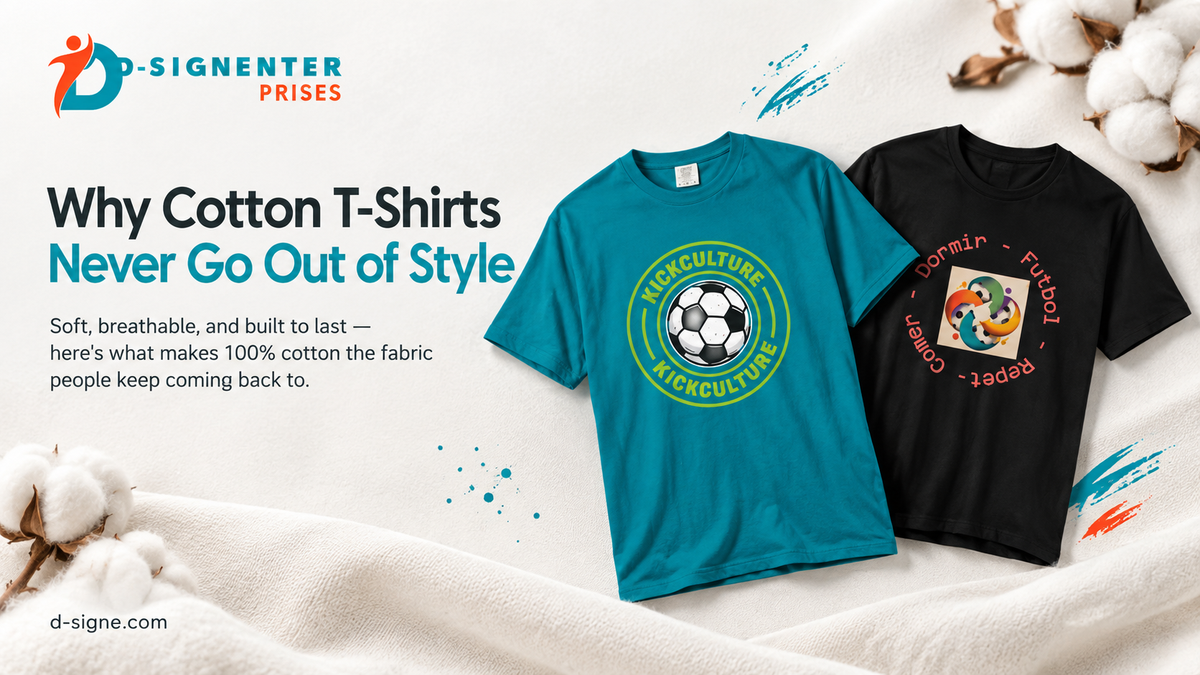
You spent hours getting the design right, the colors, the linework, the placement. But the moment it lands on the wrong blank, all that effort can fall apart. Stiff fabric that cracks the print after one wash, a scratchy weave nobody wants against their skin, or a fit that looks nothing like the mockup the shirt underneath your design carries just as much weight as the artwork itself.
That's why choosing the right cotton t-shirts matters as much as the print job. The fabric you start with determines how vibrant your ink looks, how long it lasts, and how comfortable people feel wearing it. This guide breaks down exactly what to look for in cotton tees for custom graphic designs from fabric type to fit to budget so your next print run feels great, prints clean, and doesn't strain your bottom line.
Discover D-Signe's complete lineup of custom apparel solutions designed to help your brand create standout, high-quality printed merchandise and find the perfect blank for your next design.
Why Cotton Is the Gold Standard for Custom Graphic Tees
When it comes to custom graphic tees, cotton has earned its reputation as the industry standard and for good reason. Unlike polyester or synthetic blends, cotton is a natural, breathable fiber that allows air to circulate against the skin. That breathability translates directly into all-day comfort, which matters just as much to your customers as the design itself. A shirt that traps heat or clings uncomfortably gets worn once and forgotten; a shirt that breathes gets worn on repeat.
Cotton also outperforms synthetic fabrics when it comes to ink absorption. The natural fibers soak up screen print inks, DTG (direct-to-garment) inks, and heat-transfer vinyl far more evenly than polyester's tightly woven, moisture-wicking surface. That means sharper edges, more accurate colors, and prints that sit into the fabric rather than sitting on top of it, a difference you can literally feel when you run a hand across a finished shirt.
Finally, cotton ages the way people actually want their favorite shirt to age. Instead of pilling, static-clinging, or losing its shape after a few washes, quality cotton softens over time while holding its structure. That slow, graceful wear keeps your custom graphic looking sharp wash after wash, extending the life of every print you produce.
Ring-Spun vs. Combed vs. Regular Cotton: Which Prints Best?
Not all cotton is created equal, and understanding the difference can save you from a disappointing print run. Three terms come up constantly when shopping for blank t-shirts for printing: ring-spun, combed, and regular (or "open-end") cotton.
Ring-spun cotton t-shirts are made by twisting and thinning cotton fibers into a fine, strong yarn. The result is a smoother, softer fabric surface with fewer loose fibers poking out exactly what a crisp, detailed graphic needs. Fine linework, gradients, and small text all render more accurately on ring-spun cotton because the ink bonds to a cleaner surface instead of catching on rough or uneven fibers.
Combed cotton takes the process a step further. Before spinning, the fibers are "combed" to remove impurities, short fibers, and debris, leaving only the longest, strongest strands behind. This extra processing step produces a noticeably softer, more durable, lint-free fabric often marketed as a premium option. Combed and ring-spun cotton are frequently blended together ("combed ring-spun") for the softest, cleanest printing surface available.
Then there's the fabric composition question: 100% cotton t-shirts for custom designs versus cotton-poly blends. Pure cotton is generally the better choice for print vibrancy and color accuracy, since the fibers absorb ink fully rather than resisting it. Cotton-poly blends offer more stretch, wrinkle resistance, and durability useful for athletic-fit designs or garments that need to hold up to heavy movement though often at a slight cost to how saturated the ink appears.
For most custom apparel projects prioritizing print quality, ring-spun or combed 100% cotton is the safer bet.
Shop our full collection of premium ring-spun cotton t-shirts built specifically for vibrant, long-lasting custom graphic tee designs and match the right blank to the right project before you commit to a print run.
Best Cotton Tee Picks for Men, Women & Kids
Choosing the right blank isn't one-size-fits-all the ideal cotton t-shirt changes depending on who's wearing it and what the design calls for.
For unisex, classic-fit blanks, look for a true crew neck with a straight body cut and standard sleeve length. This boxier fit gives bold, oversized graphics room to sit flat across the chest without distorting at the seams, which is why it remains the go-to choice for streetwear brands, event merch, and statement tees.
Women's styles typically fall into two categories: fitted (with side seams and a tapered waist) and relaxed (a looser, boyfriend-style cut). Fitted tees work well for smaller, centered designs, since the contoured shape keeps the graphic from stretching or warping. Relaxed-fit women's tees handle larger chest-placed prints better, giving the ink room to lay flat across a straighter panel of fabric.
Kids' tees come with their own requirements. Because children's clothing goes through the wash far more often, look for softer fabric weights, tagless necklines to prevent irritation, and shrink-resistant cotton that holds its size after repeated laundering. A shirt that shrinks two sizes after one wash doesn't just disappoint, it wastes the print entirely.
Whatever your audience, Shop our full collection of premium ring-spun cotton t-shirts built specifically for vibrant, long-lasting custom graphic tee designs and match the right blank to the right project before you commit to a print run.
Affordable Doesn't Mean Cheap: Finding Value Without Sacrificing Quality
Price differences between cotton t-shirt suppliers usually come down to three factors: fabric weight (measured in GSM, or grams per square meter), finishing quality, and brand reputation. A heavier, more tightly woven fabric costs more to produce but holds its shape and print far longer than a thin, loosely knit alternative.
This is where "budget" blanks often cut corners. Thin fabric shows through under bright screen print inks, seams fray after a handful of washes, and inconsistent dye lots can lead to visible color bleeding especially on darker shirts paired with lighter inks. None of these issues show up until after you've already invested in printing, which makes a cheap blank a costly mistake in hindsight.
The good news: affordable doesn't have to mean low-quality. Buying blank tees for printing in bulk or multi-packs is one of the most effective ways to lower your per-shirt cost without dropping down to a lower fabric grade. This works especially well for small businesses, schools, event organizers, and families ordering matching designs, since the savings scale directly with order size. The key is comparing GSM and fabric composition across suppliers rather than shopping on price alone; a slightly higher per-shirt cost on a quality blank almost always pays for itself in fewer reprints and happier customers.
Matching Fabric Weight & Fit to Your Design
Fabric weight plays a bigger role in your final print than most people expect. Lightweight cotton, generally in the 4–5 oz range, drapes softly against the body and feels ideal for everyday, casual wear but it can show more texture through the ink on large, solid-color graphics. Heavyweight cotton, 6 oz and above, offers a sturdier, more structured base that holds bold, high-coverage designs without the fabric moving or distorting underneath the print.
Fit matters just as much as weight. A slim-fit tee stretches more across the chest and shoulders during wear, which can gradually crack or warp a rigid ink print over time. Classic and relaxed fits move less, giving screen print and heat-transfer designs a more stable surface that holds its shape wash after wash.
Finally, consider how shirt color interacts with your design. Light-colored blanks let most ink types show through with full opacity and accurate color, while dark shirts require an under base (a layer of white ink beneath the design) to keep colors from muddying against the fabric. If your design uses light or pastel tones, factor in this extra step when planning both your budget and your color palette.
Shop our full collection of premium ring-spun cotton t-shirts built specifically for vibrant, long-lasting custom graphic tee designs and match the right blank to the right project before you commit to a print run.
Frequently Asked Questions
What is the best cotton for custom t-shirt printing?
Ring-spun or combed 100% cotton is widely considered the best fabric for custom t-shirt printing. Its fine, tightly spun fibers create a smooth, lint-free surface that absorbs screen print, DTG, and heat-transfer inks evenly, producing sharper details, more accurate colors, and prints that last through repeated washing without cracking or fading.
Is 100% cotton better than a blend for printing?
For most custom graphics, yes. 100% cotton absorbs ink more fully than cotton-poly blends, resulting in richer color and better ink adhesion. Blends offer more stretch and wrinkle resistance, but they typically sacrifice some print vibrancy in exchange.
What GSM is best for custom t-shirts?
Most custom apparel performs well between 5–6.5 oz (roughly 150–200 GSM). This range balances comfort and drape with enough structure to support bold, detailed graphics without the fabric feeling stiff or overly thin.
Does cotton shrink after printing or washing?
Untreated cotton can shrink slightly, typically 3–5%, after its first few washes. Pre-shrunk cotton fabric is treated during manufacturing to minimize this, making it a safer choice for designs with precise placement or sizing requirements.
What's the difference between ring-spun and regular cotton?
Ring-spun cotton is spun into a finer, stronger yarn, creating a softer feel and a smoother printing surface. Regular (open-end) cotton uses shorter, coarser fibers, resulting in a rougher texture that's more prone to pilling and less ideal for detailed prints.
Ready to Upgrade Your Next Print Run?
Comfort, print quality, and budget don't have to compete with each other; they just require the right blank from the start. Ring-spun or combed 100% cotton t-shirts for custom designs give your graphics a softer feel, sharper prints, and longer-lasting color, while matching fabric weight and fit to your specific project keeps every shirt looking the way it was meant to.
Ready to start? Discover D-Signe's complete lineup of custom apparel solutions designed to help your brand create standout, high-quality printed merchandise and find the perfect blank for your next design. Not sure which fabric weight or fit is right for your project? Order a sample pack before committing to a bulk order. It's the easiest way to test print quality firsthand before you scale up.
D-Sign Enterprises
- Phone: +1 (678) 741-7115
- E-Mail: raymond.brooks@dsignenterprise.com
- Address: 207 Meadow Creek Way, Woodstock, GA 30188, United States


Leave a comment
This site is protected by hCaptcha and the hCaptcha Privacy Policy and Terms of Service apply.